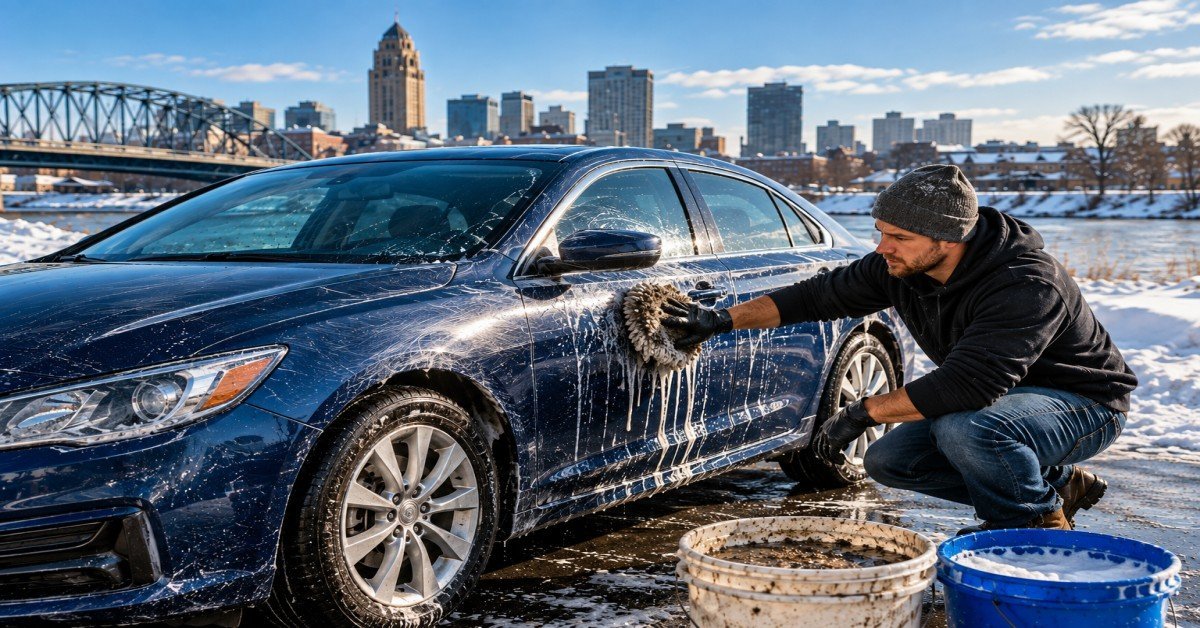
Washing your car on a sunny driveway across Western New York feels like a rewarding weekend routine, but common diy car wash mistakes can quietly ruin your vehicle’s factory clear coat. Between lake-effect weather, road salt brine, and abrasive street grime, washing your vehicle requires the right technique. Without proper methods, well-intentioned DIY washing turns dirt into fine sandpaper, leaving behind spiderweb swirl marks, deep scratches, and premature clear coat oxidation.
Automotive clear coat is delicate—often measuring thinner than a single post-it note. When vehicle owners make frequent diy car wash mistakes, they drag sharp mineral particles directly across the finish rather than lifting them away safely. To protect your investment and keep your finish looking glossy, here are 7 critical diy car wash mistakes to avoid, along with shop-tested methods to protect your paint.
Common DIY car wash mistakes include using household dish soap, washing hot panels in direct sunlight, skipping touchless pre-rinse foam, scrubbing in circular motions, using a single bucket without grit guards, cross-contaminating paint with wheel brushes, and drying with abrasive cotton towels.
Table of Contents
- 1. Why Common Errors Ruin Automotive Clear Coat
- 2. Mistake 1: Using Household Dish Soap Instead of Dedicated Car Shampoo
- 3. Mistake 2: Washing in Direct Sunlight on Hot Metal Panels
- 4. Mistake 3: Skipping the Pre-Rinse and Snow Foam Stage
- 5. Mistake 4: Using a Single Wash Bucket Without Grit Guards
- 6. Mistake 5: Scrubbing in Aggressive Circular Motions
- 7. Mistake 6: Using the Same Wash Mitt on Wheels and Body Panels
- 8. Mistake 7: Drying with Bath Towels, Old T-Shirts, or Silicone Squeegees
- 9. Common DIY Wash Habits vs. Safe Detailing Practices
- 10. How to Repair Paint Damage Caused by Past Wash Habits
- 11. Frequently Asked Questions About DIY Car Washing
Why Common Errors Ruin Automotive Clear Coat
Modern automotive paint systems rely on a multi-layer defense: an electrocoat primer, a color base coat, and an exterior clear coat. The clear coat provides optical depth, rich gloss, and vital ultraviolet (UV) protection. However, it is highly sensitive to friction and abrasive surface contact.
When drivers commit repeated diy car wash mistakes, sharp debris bonds to wash mitts and creates micro-marring. In Western New York, road grit is loaded with hard crystalline quartz and coarse winter salt crystals. Dragging these minerals across unlubricated paint scatters light reflections in multiple directions, turning a deep, rich reflection into a dull, scratched surface.
Mistake 1: Using Household Dish Soap Instead of Dedicated Car Shampoo
One of the most widespread diy car wash mistakes is reaching for household dish detergent or degreasing soap. Dish soaps are formulated specifically to strip cooking oils, animal fats, and heavy grease from non-porous glass and ceramic surfaces.
When applied to automotive finishes, dish soap causes severe issues:
- Strips Protective Layers: It dissolves carnauba waxes, synthetic polymer sealants, and degrades protective paint layers.
- Dries Out Rubber and Vinyl: Harsh surfactants leach plasticizers from weather stripping, window moldings, and wiper blades, causing premature dry rot.
- Accelerates Clear Coat Oxidation: Stripping away paint protection exposes the bare clear coat to solar ultraviolet radiation, accelerating clear coat polymer breakdown as documented by the National Institute of Standards and Technology (NIST) on coating degradation.
The Professional Fix: Always use a dedicated, pH-balanced automotive shampoo rich in slick lubricants. Quality car shampoos encapsulate surface dirt so it rinses away cleanly without abrading the paint.
Mistake 2: Washing in Direct Sunlight on Hot Metal Panels
Washing your car under direct midday sunlight is one of the most damaging diy car wash mistakes vehicle owners make during summer months. When sheet metal is hot, wash water and soap foam evaporate rapidly before you can rinse them away.
This rapid evaporation triggers hard water mineral etching:
As tap water evaporates, dissolved calcium, magnesium, and sodium minerals bond directly to the hot paint surface. These mineral deposits etch into the clear coat, creating stubborn water spots that standard washing cannot remove.
The Professional Fix: Wash your car in the shade, inside a well-ventilated garage, or during early morning and late afternoon hours when body panels feel cool to the touch.
Mistake 3: Skipping the Pre-Rinse and Snow Foam Stage
Touching dry or lightly misted paint with a wash mitt is among the most abrasive diy car wash mistakes. Buffalo roads cover vehicles in heavy traffic film, industrial fallout, and winter road salt.
Road dust contains quartz silica, which has a higher mineral hardness rating than automotive clear coats. If you touch the vehicle before loosening this top layer of road grime, your wash mitt acts like a sanding block, grinding sharp particles into the finish.
The Professional Fix: Always perform an extensive, high-pressure pre-rinse from top to bottom. For optimal lubrication, apply a touchless snow foam pre-soak with a foam cannon. Allow the thick foam to dwell for 3 to 5 minutes to loosen and encapsulate surface grit before your wash mitt ever touches the car.
If you do not have a dedicated pressure washer or foam cannon setup at home to safely dissolve this grit, booking a professional mobile car wash in Buffalo, NY ensures your paint is pre-soaked with touchless decontaminating foam before any wash mitt touches the surface.
Mistake 4: Using a Single Wash Bucket Without Grit Guards
The Professional Fix: The Two-Bucket Wash Method
- Wash Bucket: Contains clean water mixed with pH-neutral car wash soap.
- Rinse Bucket: Filled with clean, pure water to flush dirt from the wash mitt after each section.
- Grit Guard Inserts: Heavy-duty radial wash screens positioned at the bottom of both buckets to trap dirt at the base, preventing abrasive re-contamination.
If you don’t have the space or equipment to set up a multi-bucket wash station at home, booking a professional exterior hand wash ensures every panel is cleaned using grit-isolated buckets and scratch-free wash media.
✨ The Professional Fix: The Two-Bucket Wash Method
- Wash Bucket: Contains clean water mixed with pH-neutral car wash soap.
- Rinse Bucket: Filled with clean, pure water to flush dirt from the wash mitt after each section.
- Grit Guard Inserts: Heavy-duty radial wash screens positioned at the bottom of both buckets to trap dirt at the base, preventing abrasive re-contamination.
Mistake 5: Scrubbing in Aggressive Circular Motions
Generations of drivers were taught the traditional circular scrubbing method. However, circular scrubbing remains one of the primary diy car wash mistakes responsible for round, multi-directional swirl marks visible under bright sunlight or streetlights.
Circular scrubbing drags loose grit in 360-degree loops across the clear coat. Because sunlight catches circular scratches from every possible viewing angle, circular marring makes paint look cloudy and worn. If circular scrub marks have already dulled your finish, investing in professional paint polishing and waxing is the only way to level the clear coat and restore optical depth.
The Professional Fix: Always wash panels in straight, overlapping lines. Move front-to-back on horizontal surfaces (hood, roof, trunk) and top-to-bottom on vertical panels (fenders, doors). Wash with gentle pressure and let the soap’s lubricity lift the dirt.
Mistake 6: Using the Same Wash Mitt on Wheels and Body Panels
Wheels and lower rocker panels collect concentrated metallic brake dust, corrosive road salt, and asphalt tar. Using the same sponge, mitt, or water bucket on both wheels and painted body panels is among the most destructive diy car wash mistakes.
Brake dust consists of microscopic, razor-sharp iron particles shed from brake rotors. Transferring these metal shards onto painted body panels gouges deep scratches into the clear coat.
The Professional Fix: Maintain a completely separate wheel bucket, soft wheel brushes, and dedicated wheel wash mitts. Always clean wheels, tires, and wheel wells first before washing painted exterior body panels.
Mistake 7: Drying with Bath Towels, Old T-Shirts, or Silicone Squeegees
Allowing a car to air dry causes hard water spots, but drying with old household bath towels, terrycloth rags, or silicone water blades is one of the most common vehicle care errors.
Household bath towels feature looped cotton fibers that trap stray dust particles and drag them across the paint surface. Silicone squeegees can trap a single speck of dust underneath the blade edge and drag a deep scratch across the entire length of your hood or door.
The Professional Fix: Use a dedicated, plush microfiber drying towel (500+ GSM) with edgeless borders. Alternatively, use a filtered, heated warm-air blower for 100% scratch-free, contact-free drying.
Common DIY Wash Habits vs. Safe Detailing Practices
| Wash Habit | Clear Coat Consequence | Recommended Detailing Method |
|---|---|---|
| Household Dish Soap | Strips wax/sealants, oxidizes clear coat | Use dedicated pH-neutral automotive shampoo |
| Direct Sunlight Washing | Severe mineral etching & soap staining | Wash in shade when panels are cool to the touch |
| Skipping Pre-Rinse | Grinds abrasive grit into the clear coat | Perform high-pressure rinse & snow foam soak |
| Single-Bucket Wash | Cross-contaminates wash mitt with abrasive grit | Use two buckets with grit guard inserts |
| Circular Scrubbing | Creates visible 360-degree spiderweb swirls | Wash gently in straight, overlapping lines |
| Shared Wheel Tools | Deposits metallic brake dust on body panels | Use separate wheel buckets, brushes, and mitts |
| Cotton Bath Towel Drying | Severe friction hazing and micro-scratches | Use plush 500+ GSM edgeless microfiber towels |
How to Repair Paint Damage Caused by Past Wash Habits
If past diy car wash mistakes have already left your clear coat covered in swirl marks, dull haze, or water spots, standard hand washing cannot reverse the damage. These micro-scratches require precision mechanical leveling.
Professional paint correction uses dual-action rotary polishers with specialized foam pads to safely level clear coat imperfections. To eliminate spiderweb swirls and restore a deep, mirror-like gloss, schedule a professional exterior car wash and polishing in Buffalo, NY.
Ready to Restore & Protect Your Vehicle’s Paint?
Don’t let clear coat swirls and scratch damage get worse. Schedule a professional paint evaluation or explore our safe, two-bucket exterior detailing packages today.
Frequently Asked Questions About DIY Car Washing
What is the most damaging car wash mistake you can make at home?
The most damaging mistake is washing in circular motions using a single dirty bucket without grit guards. This drags sharp quartz dirt across the surface, inflicting deep circular swirl marks into the clear coat that require machine polishing to remove.
Can clear coat scratches caused by diy car wash mistakes be removed by hand?
Very light clear coat hazing can sometimes be improved with hand polish, but moderate swirl marks and wash scratches caused by improper washing require machine paint correction using a dual-action polisher and calibrated polishing compounds.
How often should I wash my car in Western New York?
During standard spring and summer driving, a thorough wash every two weeks prevents road grime and bug splatter from bonding to the paint. During winter months with heavy road salt and magnesium chloride, a weekly touchless or professional two-bucket wash is recommended to prevent underbody and clear coat corrosion.
Are automatic brush car washes safer than washing my car at home?
No. Commercial automatic brush car washes use heavy friction curtains that retain grit and abrasive sand from hundreds of previous vehicles. These spinning brushes inflict deep swirl marks and marring on clear coats. A careful two-bucket hand wash or professional mobile detailing service is far safer for your vehicle’s finish.
What is the safest way to dry a car without scratching the clear coat?
The safest method is using an edgeless, high-density microfiber drying towel (500+ GSM) paired with a spray detailer as a drying aid, or using a warm-air touchless blower to blow water out of crevices without any physical contact.