When Buffalo vehicle owners look at their road-salt-covered cars after a harsh Western New York winter, washing them is an immediate priority. However, whether you wash your vehicle in your driveway or head to a commercial facility, water usage adds up quickly. Evaluating mobile car wash water consumption helps you make an eco-conscious choice that protects your vehicle’s clear coat, lowers municipal resource strain, and preserves local Lake Erie watersheds.
⚡ Quick Answer: Does a mobile car wash use less water in Buffalo, NY?
Yes. A professional mobile car wash uses only 5 to 15 gallons of water per vehicle, compared to 80 to 140 gallons for a standard home garden hose and 35 to 80 gallons for an automatic tunnel wash. This saves up to 80% of water while completely eliminating hazardous chemical runoff into Lake Erie watersheds.
Traditional driveway washing with a standard garden hose can easily waste over 100 gallons of potable water per session, most of which drains directly into street storm sewers untreated. By contrast, booking a professional mobile car wash in Buffalo, NY gives vehicle owners access to advanced pressure management and closed-loop wash techniques that dramatically lower total resource draw while delivering superior detailing results.
- Mobile Car Wash Water Consumption: The Raw Numbers
- Mobile Detailing vs. Traditional Car Wash Methods
- How Mobile Car Washes Minimize Water Usage
- Environmental Regulations and Stormwater Runoff in Erie County
- Eco-Friendly Mobile Fleet & Commercial Solutions
- Frequently Asked Questions
- Schedule Your Eco-Conscious Mobile Detail in Buffalo
Mobile Car Wash Water Consumption: The Raw Numbers
The metric that surprises most vehicle owners across Erie County is the vast difference in total gallons consumed per cleaning cycle. A thorough breakdown of mobile car wash water consumption reveals that professional mobile units operate on a fraction of the volume required by conventional automated tunnels or residential garden hoses.
Average Water Use by Car Wash Method:
- Standard Home Garden Hose: 80 – 140 gallons per wash
- Commercial In-Bay Automatic Wash: 35 – 80 gallons per cycle
- Self-Serve Coin Wash Bays: 15 – 35 gallons per cycle
- Professional Mobile Car Wash Unit: 5 – 15 gallons per complete wash
- Rinseless / Steam Detailing Method: 1 – 3 gallons per vehicle
Because professional mobile detailers rely on high-pressure, low-volume (HPLV) spray equipment and specialized emulsification soaps, they do not require continuous running water. This targeted approach keeps overall resource draw strictly controlled, lifting stubborn road grime without flooding your driveway or parking stall.
Mobile Detailing vs. Traditional Car Wash Methods
To understand why mobile car wash water consumption remains so low compared to traditional alternatives, it helps to examine how different washing techniques utilize and manage water.
| Car Wash Method | Average Water Used | Runoff Management | Paint Safety Level | Convenience |
|---|---|---|---|---|
| ✨ Professional Mobile Wash | 5 – 15 Gallons | Minimal to Zero Runoff | High (Two-bucket / foam cannon) | Comes directly to your doorstep |
| Home Driveway Hose | 80 – 140 Gallons | Drains into local storm sewers | Low (Risk of swirl marks) | High DIY labor required |
| Commercial Tunnel / Automatic | 35 – 80 Gallons | On-site reclamation systems | Low (Abrasive rotating brushes) | Driving & waiting in lines |
| Self-Serve High-Pressure Bay | 15 – 35 Gallons | Commercial oil-water separators | Medium (Abrasive foaming brooms) | Travel & manual labor required |
The Driveway Hose Myth
Many drivers assume washing a vehicle at home is the most economical and eco-friendly option. In reality, an unrestricted 5/8-inch garden hose running at 40–60 PSI delivers between 8 and 12 gallons of water every minute. Spending just 10 to 12 minutes rinsing a vehicle results in more than 100 gallons entering the municipal drainage system. Measuring realistic on-demand mobile detailing water volume proves that on-demand professionals consume up to 80% less water than a typical DIY driveway session.
Commercial Car Wash Inefficiencies
While commercial tunnel washes often feature reclamation systems, older or improperly maintained facilities lose up to 40% of their water to evaporation, vehicle carryout, and filter blowdown. Furthermore, the harsh friction brushes used in many automatic car washes frequently cause micro-marring and swirl marks across your clear coat.
🚗 Save 80+ Gallons on Your Next Wash
Skip the driveway runoff and hassle. Our mobile detailing unit comes fully equipped to your Buffalo home or workplace with spot-free, eco-safe water.
How Mobile Car Washes Minimize Water Usage
Mobile detailing rigs operating in Western New York are engineered from the ground up for precision resource management. Several core technologies keep mobile car wash water consumption strictly regulated:
1. High-Pressure, Low-Flow Delivery
Professional mobile detailing setups utilize specialized pressure pumps designed to atomize water at 1,000 to 1,500 PSI while delivering a flow rate of only 1.2 to 2.0 gallons per minute (GPM). This concentrated pressure shears through winter road salt and summer bugs instantly, requiring only short bursts of water rather than a continuous stream.
2. High-Lubricity Foam & Polymer Chemistry
Modern mobile detailing utilizes pH-balanced, hyper-surfactant snow foams that encapsulate dirt particles on contact. By breaking surface tension chemically, dirt lifts cleanly away from the automotive paint, requiring minimal rinse water to wash clear and reducing overall gallon requirements.
3. Rinseless and Waterless Wash Formulations
For light maintenance cleans and dust removal in corporate parking lots or residential complexes, mobile detailers employ advanced rinseless polymers. Utilizing specialized waterless and rinseless car wash services requires only 2 to 4 gallons of water total in a dedicated wash bucket, completely bypassing the need for an external pressure washer rinse cycle.
Environmental Regulations and Stormwater Runoff in Erie County
Beyond evaluating direct mobile car wash water consumption, the environmental impact of wash runoff is a major concern for local property owners.
Under the federal Clean Water Act regulated by the U.S. Environmental Protection Agency (EPA), residential car wash runoff is classified as non-point source pollution when it enters municipal separate storm sewer systems (MS4s). When you wash a car in a driveway in Buffalo, Amherst, or Cheektowaga, untreated wash water carrying petroleum hydrocarbons, heavy metals, brake dust, and phosphates drains directly into municipal storm drains:
Unlike indoor plumbing, outdoor storm drains lead directly into Western New York waterways without passing through a municipal wastewater treatment facility.
Professional mobile detailing eliminates heavy surface pooling and toxic chemical discharge. By combining biodegradable cleaning solutions with measured, low-volume water applications, optimizing on-site mobile detailing water efficiency protects the Western New York watershed from hazardous contaminant runoff.
Eco-Friendly Mobile Fleet & Commercial Solutions
For business owners managing service vans, delivery trucks, or corporate sales fleets across Western New York, municipal sustainability standards and water usage compliance are increasingly critical. Scheduling an on-site eco-friendly and fleet car wash in Western New York delivers a reliable, compliant way to keep company vehicles clean without exceeding municipal water allowances.
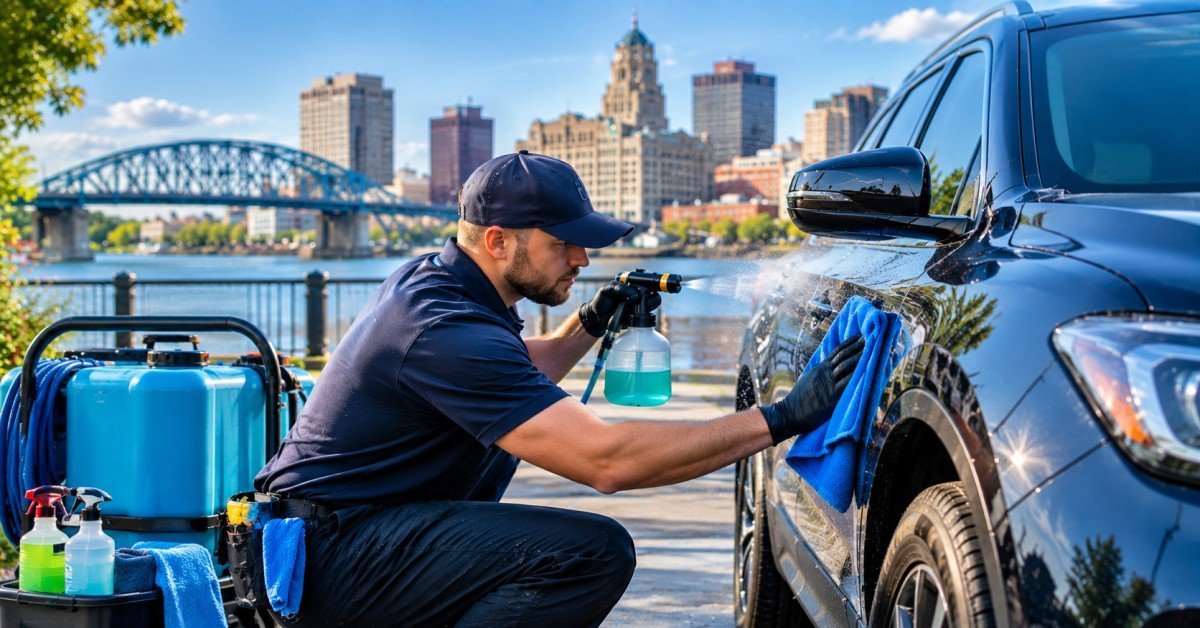
Mobile detailing teams come directly to your company parking lot or logistics yard, servicing multiple fleet vehicles sequentially with dedicated on-board water storage and zero disruption to your daily business operations. Managing commercial mobile car wash water consumption allows fleet operators to maintain immaculate branding while significantly reducing their environmental footprint.
Frequently Asked Questions
Does lower mobile car wash water consumption increase the risk of scratching paint?
No. High-lubricity detailing soaps, foam cannons, and ultra-plush microfiber wash mitts safely encapsulate grit before water touches the surface. Mechanical friction is minimized, making a controlled mobile wash significantly safer for automotive clear coats than automated tunnel brushes.
What is the average mobile car wash water consumption for a large SUV or truck?
For full-size SUVs, pickup trucks, or commercial cargo vans, the water needed ranges between 10 and 18 gallons, depending on the severity of winter road salt or mud buildup.
How much water does a mobile car wash use compared to an automatic car wash?
Analyzing mobile car wash water consumption shows that a mobile unit uses approximately 5 to 15 gallons per vehicle, whereas a commercial automatic car wash typically consumes between 35 and 80 gallons per wash cycle.
Do mobile detailers bring their own water supply to Buffalo homes and offices?
Yes. Professional mobile detailing rigs carry self-contained water tanks (typically 50 to 100 gallons of spot-free deionized water) and dedicated generators, requiring zero utility hookups from your home or business.
Can mobile detailing be done at apartments or condos with water restrictions?
Yes. Because professional mobile detailing setups carry their own on-board water tanks and generate virtually zero driveway runoff, tracking minimal mobile car wash water consumption ensures full compliance with strict HOA bylaws and apartment complex regulations across Erie and Niagara counties.
How does waterless car detailing work without damaging vehicle paint?
Waterless and rinseless washes use specialized polymers and emulsifiers that wrap around dirt particles to lift them away from the clear coat. When wiped gently with high-GSM microfiber towels, the dirt is safely removed with zero scratching and near-zero water waste.
Schedule Your Eco-Conscious Mobile Detail in Buffalo
Protect your vehicle’s finish while conserving Western New York’s vital water resources. Select your detailing package and schedule your arrival window online in under 60 seconds!